
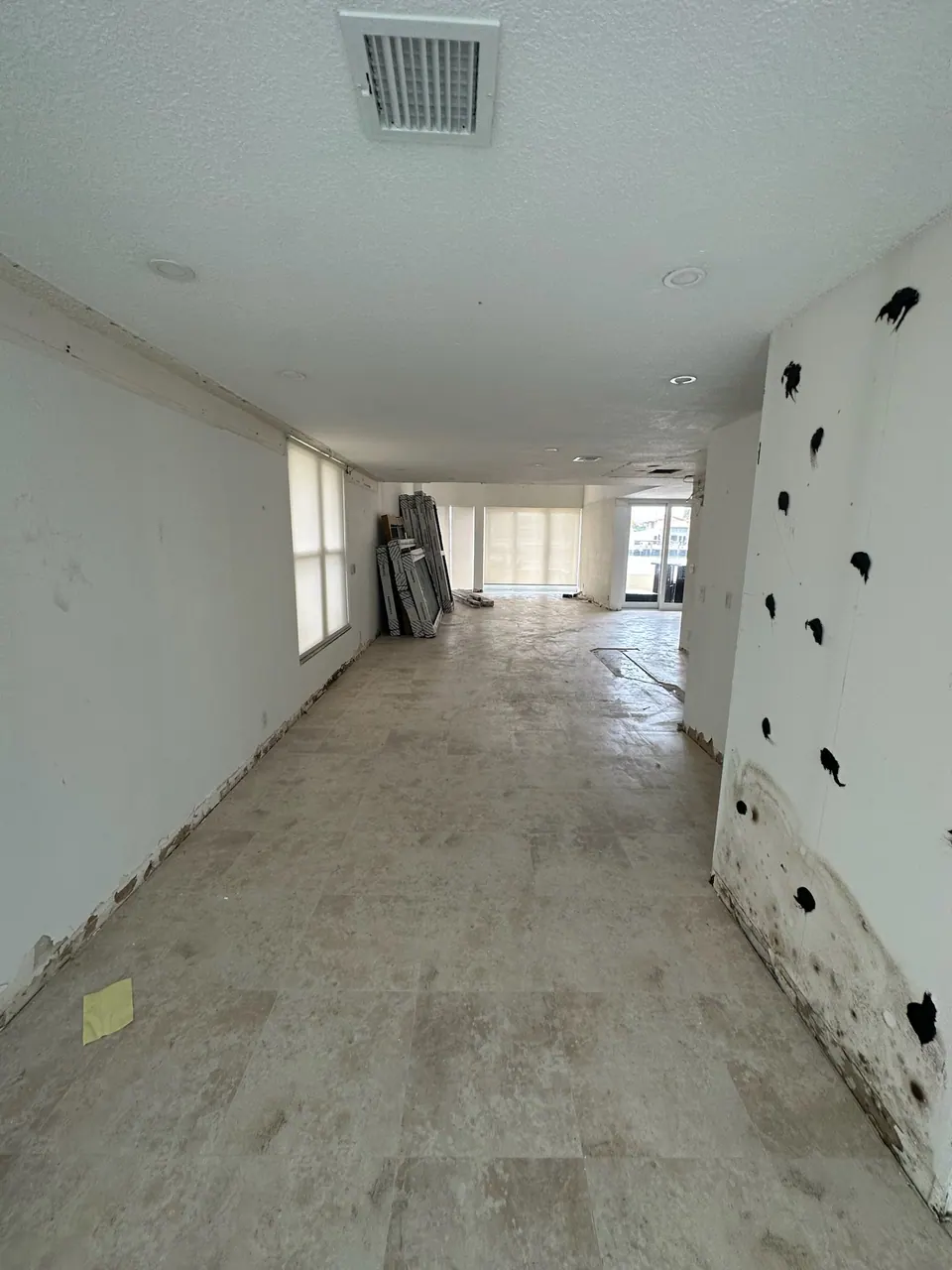
Most floor failures we are called to look at started under the floor: moisture coming up through the slab, or a slab that was never flat enough for the product on top of it.
Moisture
Concrete holds water long after it is poured, and slabs on grade can take on moisture from below. Flooring manufacturers set limits for how much moisture their products and adhesives tolerate, and they specify how that moisture must be measured. For floating laminate, the manufacturer usually requires a vapor barrier over concrete. For glue down vinyl, the adhesive has its own moisture limit. Engineered wood is the most moisture sensitive of the three, which is why its manufacturers are usually the most specific about testing.
A common measurement method is in situ relative humidity testing under ASTM F2170. In outline, probes are placed in holes drilled to a specified depth in the slab, the holes are sealed, and readings are taken after an equilibration period. The building should be at normal service conditions, with the air conditioning running, before testing begins. The standard also sets how many test locations are needed for a given floor area.
Two points matter to homeowners:
- Results describe the slab at the time and place tested. A slab tested before the air conditioning is running may read differently later.
- The manufacturer's limit is the one that counts. If readings exceed it, the options include waiting, a moisture mitigation system the manufacturer approves, or a product with a higher tolerance.
Flatness
Every flooring manufacturer publishes a flatness tolerance. Rigid core vinyl, laminate and wide plank engineered wood are particularly sensitive: dips cause hollow sounds and stress at the joints, and humps cause rocking. Preparation means grinding high spots, filling low spots with an appropriate compound, and checking with a straightedge before installation.
What we do
We check flatness at the estimate, discuss moisture whenever engineered wood, glue down products or older slabs are involved, and include preparation in the quote rather than discovering it on installation day.
Sources
- ASTM F2170, Standard Test Method for Determining Relative Humidity in Concrete Floor Slabs Using in situ Probes
- Wood Floor Business: Slab testing done right, following directions for ASTM F2170
General information only. Always follow the installation and care instructions for your specific product and the rules that apply to your building.